Documentation
K112E
Digital Compound Oscillator
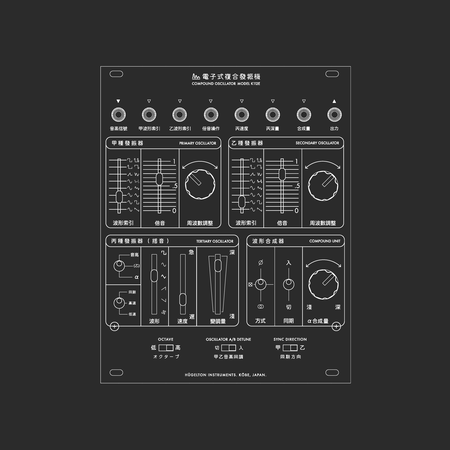
Overview
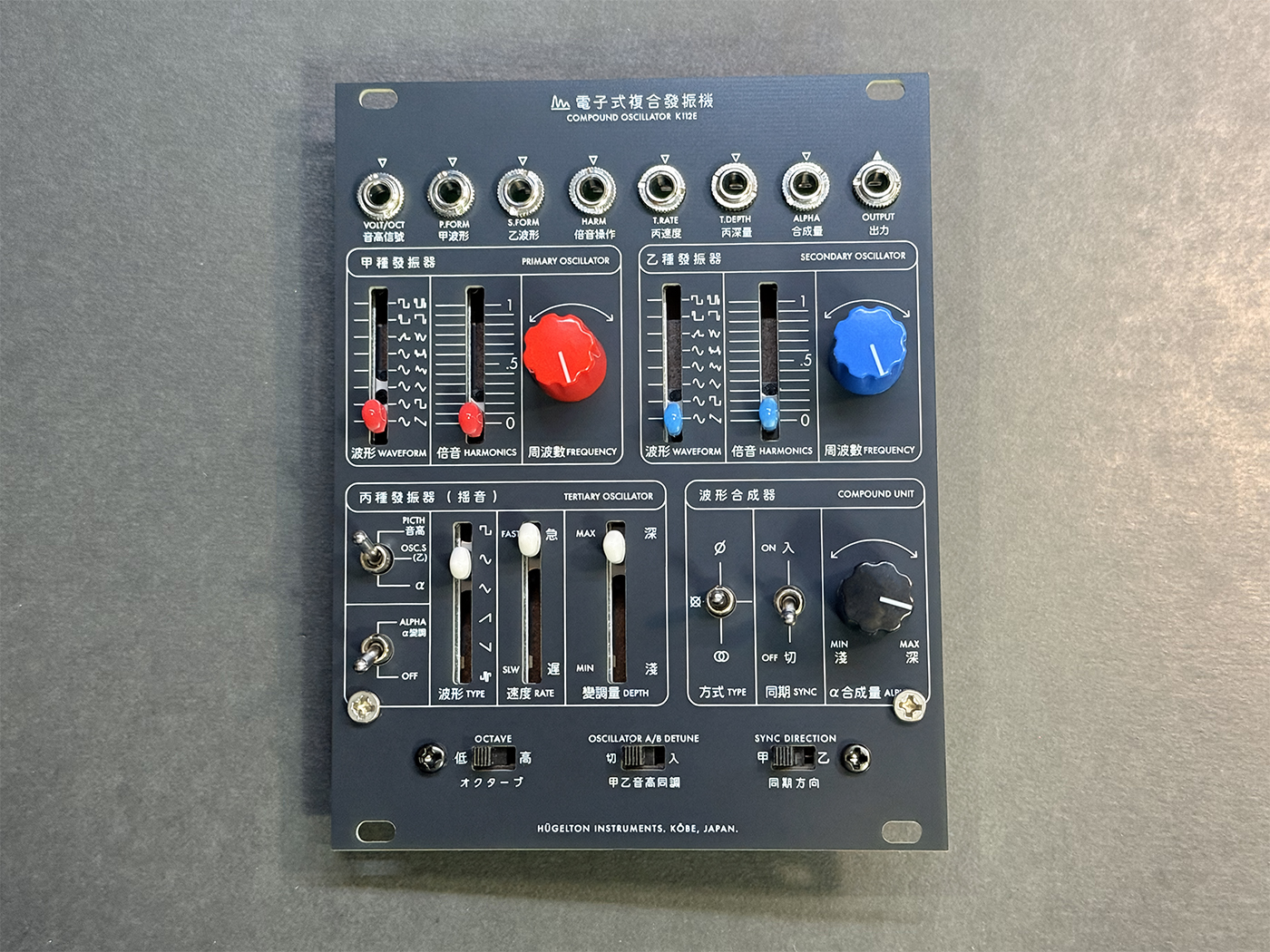
The K112E is a digital compound oscillator module developed based on our unique “Island Synthesis” philosophy, featuring:
“Island Synthesis” is a philosophy that seeks to inherit and further develop Japan’s unique electronic music art traditions in the contemporary era. From the 1960s to 1980s, synthesizer history has been told through the lens of “West Coast” and “East Coast” movements in Europe and America. However, during the same period, Japan had multiple pioneers conducting their own unique explorations. They developed distinctive circuit designs and sound synthesis methods that were not mere imitations of Western approaches, creating instruments with unique tonal characteristics.
In today’s synthesizer market, globalization has led to a tendency toward uniformity in design philosophy and sound creation methods. However, we aim to re-evaluate the originality that Japanese electronic musical instruments once possessed—their technical characteristics, aesthetics, and philosophy—and reinterpret them with modern technology.
The K112E is a digital compound oscillator module developed based on this “Island Synthesis” philosophy, featuring:
- Three-layered sound architecture using Alpha, Beta, and Gamma oscillators
- Unique waveform synthesis algorithms inheriting Japanese electronic instrument traditions
- Reconstruction of classical sound synthesis theory with modern digital technology
- Operating system where tradition and innovation converge
- Eurorack-compliant while maintaining distinctive character
Improvements over the K102E
K112E is a revised edition of the original K102E, redesigned around user feedback. It keeps the K102E’s core architecture and sound while significantly expanding voltage control and switching for greater flexibility in a modular system.
Added CV inputs
- OSC A BANK CV: selects OSC A’s waveform family
- OSC B BANK CV: selects OSC B’s waveform family
- HARMONICS CV: controls the FORM amount of both A and B together
- COMPOUND ALPHA CV: FADE mix amount, and PHASE/MULT depth
- LFO DEPTH CV
- LFO FORM CV: selects one of 7 waveforms
- LFO SPEED CV
Added switches
- COMPOUND MODE: FADE / PHASE / MULT
- LFO FOR: OSC 1+2 / OSC 2 / pitch off
- LFO to ALPHA: independent on/off to send the LFO to Compound Alpha
- SYNC DIR: inverts the master OSC during SYNC
- OCTAVE
DETUNE and SYNC carry over from the K102E; DETUNE switches OSC B to track OSC A.
Panel / Controls
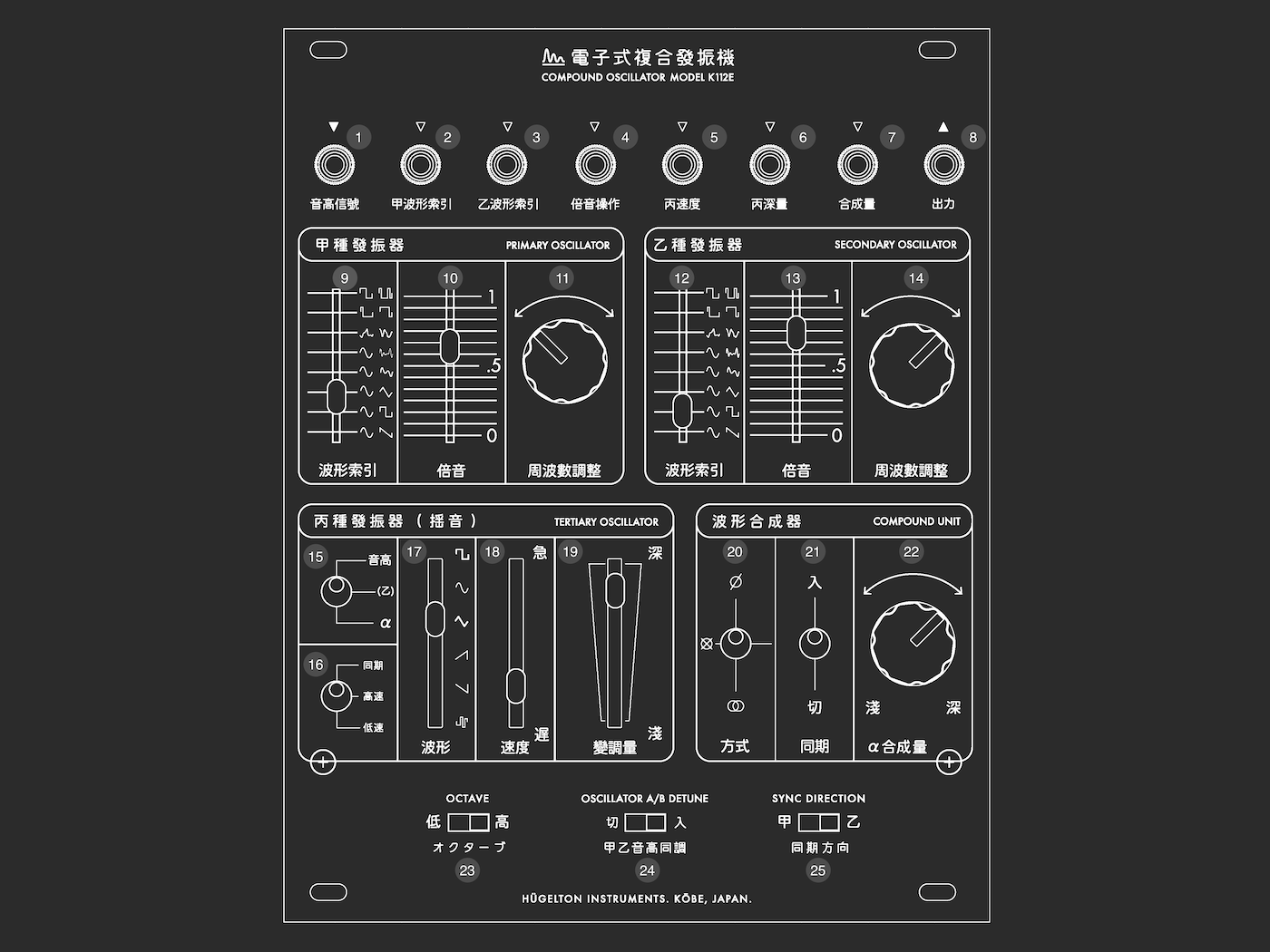
| No. | Name | Function |
|---|---|---|
| 1 | Pitch signal | Pitch CV input (V/Oct, 0-5V) |
| 2 | OSC A wave index | OSC A waveform-bank select CV (0-10V) |
| 3 | OSC B wave index | OSC B waveform-bank select CV (0-10V) |
| 4 | Harmonics control | Harmonics (FORM) CV for both A and B (0-10V) |
| 5 | LFO speed | LFO speed CV (0-10V) |
| 6 | LFO depth | LFO depth CV (0-10V) |
| 7 | Compound amount | Compound Alpha CV (0-10V) |
| 8 | Output | Audio output (±5Vpp) |
| 9 | Wave index (A) | OSC A waveform bank / read position |
| 10 | Harmonics (A) | OSC A harmonics (FORM) amount |
| 11 | Frequency (A) | OSC A frequency |
| 12 | Wave index (B) | OSC B waveform bank / read position |
| 13 | Harmonics (B) | OSC B harmonics (FORM) amount |
| 14 | Frequency (B) | OSC B frequency |
| 15 | LFO destination | LFO target (pitch / OSC B / α) |
| 16 | LFO range | LFO speed range (sync / high / low) |
| 17 | LFO waveform | LFO waveform select |
| 18 | LFO speed | LFO speed (fast–slow) |
| 19 | LFO depth | LFO modulation depth (deep–shallow) |
| 20 | Compound mode | FADE / PHASE / MULT |
| 21 | Sync | SYNC (on / off) |
| 22 | Compound Alpha | Compound Alpha amount (shallow–deep) |
| 23 | Octave | OCTAVE (low / high) |
| 24 | A/B Detune | DETUNE (off / on) |
| 25 | Sync direction | SYNC DIRECTION (A / B) |
Main Features
Alpha (Primary) Oscillator
- Pitch adjustment (±2 octaves)
- 8 waveform banks:
- Basic waveforms (sawtooth, square, triangle, sine)
- Metallic harmonics
- Formant (vocal) waveforms
- Linear feedback noise
- Chaotic harmonics
- 16-stage harmonic selection
- Precise wavetable read position control
Beta (Secondary) Oscillator
- Pitch adjustment (±1 octave relative to Alpha)
- Same waveform banks as Alpha
- Wavetable read position control
- Hard sync function with Alpha oscillator
Gamma (LFO) Section
- Rate: 0.005Hz to 50Hz
- Depth control
- 4 waveform types:
- Square
- Triangle
- Ramp (up/down)
- Random step
- Multiple modulation destination selection
Specifications
Basic Information
- Part Number: K112E
- Product Name: K112E Digital Compound Oscillator
Physical Specifications
- Panel width: 20HP
- Depth: 20mm
- Panel color: Black
Electrical Specifications
- Power: DC ±12V (16-pin Eurorack standard, 5V rail not used)
- Current consumption:
- +12V: 300mA (theoretical)
- -12V: 10mA (theoretical)
Input/Output Specifications
- Output: 3.5mm mono jack (±5Vpp)
- Pitch CV input: 3.5mm mono jack (V/Oct, 0-5V)
- All other CV inputs: 3.5mm mono jack (0-10V)
- OSC A BANK / OSC B BANK / HARMONICS / COMPOUND ALPHA / LFO DEPTH / LFO FORM / LFO SPEED
Wavetables and Synthesis
Waveform Banks
- Linear feedback noise: Noise generator
- Pulse width modulation: Variable duty cycle square wave
- Formant waveforms: Vocal harmonic structures
- Chaotic harmonics: Non-linear harmonic components
- Metallic harmonics: Metallic harmonic structures
- Basic waveforms:
- Sine wave
- Triangle wave
- Square wave
- Sawtooth wave
Synthesis Methods
Ø Phase Modulation (PM)
$y(t) = x1(t + \alpha x2(t))$
- Primary waveform phase modulated by secondary
- Alpha parameter controls modulation amount
- Creates new timbres through unique harmonic structures
⊗ Multiply Modulation (RM)
$y(t) = (1-\alpha)x1(t) + \alpha(x1(t) \cdot x2(t))$
- Multiplicative synthesis of primary and secondary
- Alpha parameter controls balance between original and ring-modulated sound
- Metallic timbres through new harmonic series
⊕ Cross-fade
$y(t) = (1-\alpha)x1(t) + \alpha x2(t)$
- Smooth transition from primary to secondary
- Alpha parameter controls crossfade amount
- Smooth morphing between two waveforms
Connection and Basic Operation
Installation Procedure
- Ensure Eurorack power is disconnected
- Verify bus cable orientation
- Install module and secure with mounting screws
Basic Operation
- Set output level to minimum during initial startup
- Adjust pitch of each oscillator
- Select desired waveforms
- Choose synthesis method and adjust alpha parameter
- Add modulation with LFO as needed
Precautions
- Check the rear screws and nuts: Due to the product’s construction, the nuts on the rear panel can work loose. Before rack-mounting, make sure the nuts are tight. If any part is missing or damaged, please contact us.
- Always minimize output level when powering on/off
- Input signals within specified voltage range to CV inputs
- Make connections carefully to prevent damage from excessive input
- Use in environment with adequate ventilation